Nigeria Ebola Update 2026: Symptoms, Prevention and Safety Tips
Nigeria has confirmed an imported Ebola case in Abuja. Learn how Ebola spreads, recognise symptoms, protect your family and separate facts from rumours.
Imagine a woman returning to Nigeria after an international trip. A few days later, she begins to feel unwell. She seeks medical attention, expecting an ordinary illness. But after further investigations, health officials confirm something far more serious: Ebola disease.
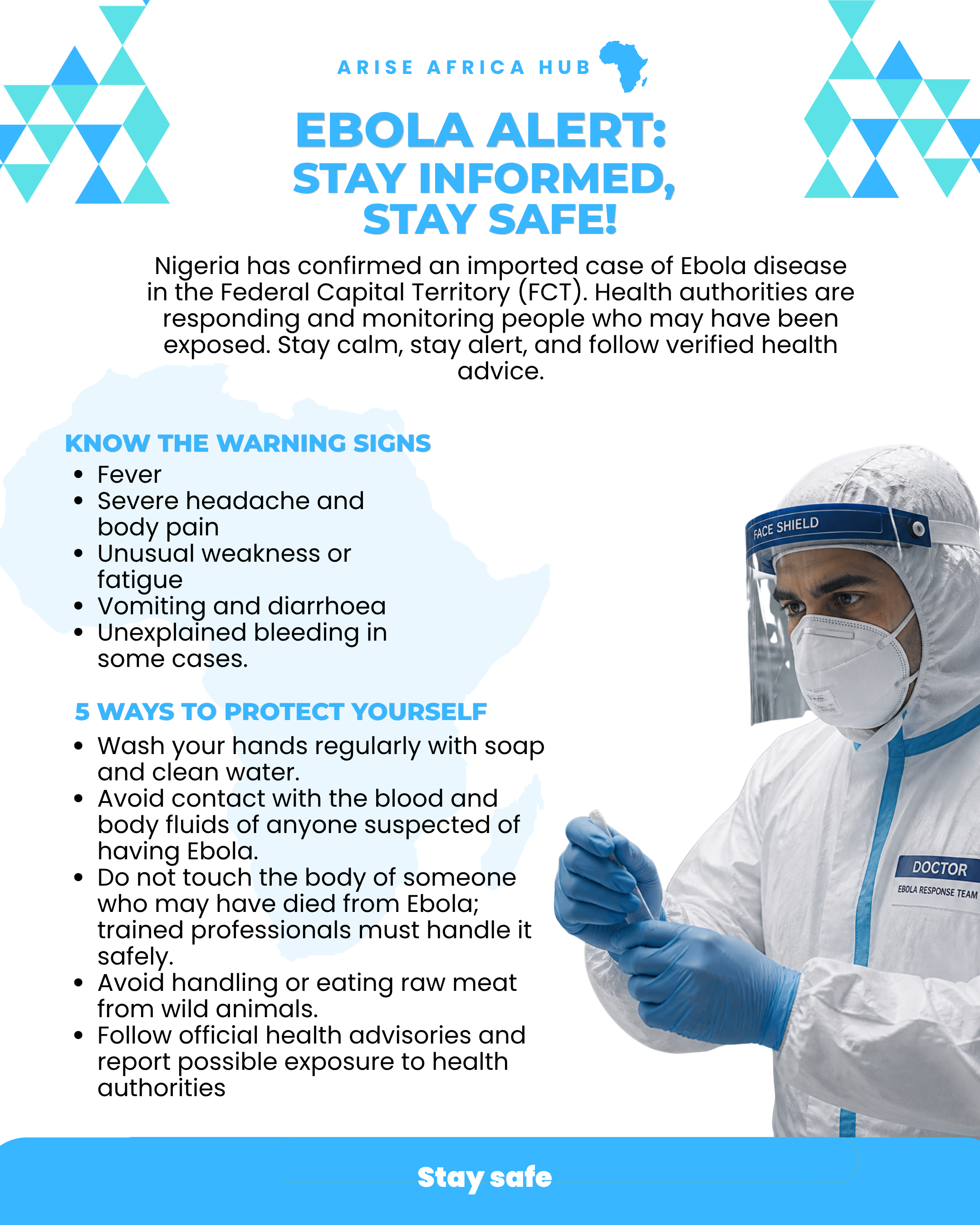
This is not a hypothetical description of the latest news. On 20 October 2026, Nigerian authorities confirmed an imported case of Ebola Bundibugyo virus disease in the Federal Capital Territory (FCT), Abuja. The patient had recently travelled from Uganda and was placed in isolation for medical care. Public health authorities reported that 44 contacts had been identified for monitoring. WHO’s official situation update.
For many Nigerians, the news raises understandable questions:
- Is Ebola spreading across Nigeria?
- How does the virus spread from one person to another?
- Should we be afraid of visiting hospitals or travelling?
- What can families, market traders, schools and communities do to protect themselves?
At Arise Africa Hub, we believe that health information should do more than announce danger. It should help people understand the danger, recognise what matters and take practical steps to protect themselves and others.
Let us separate the facts from the fear.
1. What is happening with Ebola in Nigeria right now?
Nigeria has confirmed one imported case of Ebola Bundibugyo virus disease in Abuja as of the official reports available for this article. The case was confirmed in the laboratory on 20 October 2026, and the patient was receiving care in isolation.
The Nigeria Centre for Disease Control and Prevention (NCDC) activated its incident management system, while health authorities began contact tracing and strengthened infection prevention measures.
What does “imported case” mean?
It means the infection was associated with exposure outside the country before the case was detected in Nigeria. It does not automatically mean that the virus is spreading widely within Nigerian communities.
The identification of contacts is also not proof that those people have Ebola. They are being monitored because they may have had an exposure that needs to be assessed.
According to the World Health Organization's 23 October 2026 update, the wider outbreak of Bundibugyo virus disease continues in the Democratic Republic of the Congo, while Kenya has also reported cases linked to an imported infection.
Nigeria's confirmed case therefore calls for vigilance, early reporting and effective public health action—not rumours or discrimination.
2. Meet the people behind the everyday safety decisions
Story One: The trader who almost ignored the warning
A market trader named Amina hears about Ebola from a radio programme while arranging her goods for the day.
Her first reaction is to dismiss the news. She remembers hearing about other disease outbreaks and assumes that nothing she does will make a difference.
Later that afternoon, she hears someone claim that Ebola can be prevented by drinking a mixture of salt water and herbs. The advice sounds simple, affordable and familiar.
Fortunately, Amina decides to verify the information before acting on it.
She learns that there is no scientifically established home remedy that prevents or cures Ebola. She also learns that the virus is not spread simply because someone hears about it, shares a market space with an infected person without relevant exposure, or lives in the same city.
Amina begins practising good hand hygiene, avoids contact with anyone's body fluids, and shares information from reliable public health sources with her family.
Story Two: The family that chose early reporting over secrecy
Tunde returns from a trip abroad. A few days later, he develops a fever, feels weak and complains of body pain.
His family assumes he has malaria. One relative suggests buying medication from a nearby chemist, while another insists that they should keep his illness private to avoid being embarrassed.
But Tunde remembers hearing that some infections can initially resemble common illnesses.
He contacts a healthcare provider, explains his symptoms and recent travel history, and follows the instructions given by health professionals.
The healthcare team assesses his condition and determines the appropriate next steps.
Tunde's actions do not mean that he has Ebola. Fever and body pain can have many causes, including malaria and other infections. However, providing accurate information about recent travel and possible exposure helps health professionals assess the risk appropriately.
Story Three: The nurse who remembered that safety begins before treatment
At a busy health facility, a patient arrives with fever, weakness and a history of recent travel to an area affected by an infectious disease outbreak.
The nurse does not immediately assume that the patient has Ebola. Instead, she follows the facility's infection prevention procedures, alerts the appropriate team and ensures that the patient is assessed safely.
The facility arranges appropriate precautions and further evaluation.
The nurse understands that protecting patients also means protecting healthcare workers, cleaners, laboratory personnel, caregivers and other people who may be present.
3. How does Ebola spread?
Ebola virus disease is a serious illness caused by viruses in the Orthoebolavirus genus. The current Nigerian case involves the Bundibugyo virus.
Ebola can spread through direct contact with the blood or other body fluids of a person who is sick with the disease, or through contaminated objects such as needles, clothing or bedding. Exposure to infected animals or their blood and tissues can also transmit certain Ebola viruses.
Body fluids may include vomit, diarrhoea, urine, saliva, breast milk, semen and other fluids from an infected person.
The risk is especially important when someone provides care to a sick person without appropriate protection, handles contaminated materials, or participates in unsafe burial practices.
Ebola is not ordinarily transmitted through the air like measles or influenza. Being in the same city, hearing someone cough from a distance, or simply discussing the disease does not mean a person has been infected.
People with Ebola generally become infectious when symptoms begin. A person who has had a possible exposure should follow public health guidance, even if they currently feel well.
Understanding how the virus spreads helps us focus on meaningful precautions rather than fear.
4. What symptoms should Nigerians look out for?
Symptoms can begin between 2 and 21 days after exposure. Early symptoms may include:
- Fever
- Severe headache
- Muscle and body pain
- Weakness and fatigue
- Sore throat
- Loss of appetite
As the illness progresses, some people may develop vomiting, diarrhoea, abdominal pain, skin rash, or unexplained bleeding. Bleeding does not occur in every case.
These symptoms overlap with malaria, Lassa fever, typhoid and other illnesses. Symptoms alone cannot confirm Ebola. Laboratory testing and professional assessment are needed.
What should you do if you develop symptoms?
5. Seven practical ways to protect yourself and your family
You do not need to live in fear to take Ebola seriously. Here are seven practical steps every household can understand and apply.
1. Wash your hands properly
Wash your hands with soap and running water, particularly after using the toilet, before preparing food and after potentially contaminating activities.
Alcohol-based hand sanitiser can be useful when hands are not visibly dirty, but follow public health and healthcare guidance for the situation. Hand hygiene is important, but it does not replace avoiding contact with infectious body fluids.
2. Avoid contact with blood and other body fluids
Do not touch another person's blood, vomit, diarrhoea or other body fluids with bare hands. Avoid handling contaminated clothing, bedding or medical waste.
If you are caring for someone who may have Ebola, seek professional guidance rather than attempting to provide unprotected care.
3. Never share needles or contaminated equipment
Use sterile medical equipment and ensure that injections and other procedures are performed by qualified personnel using appropriate infection prevention measures.
Never reuse needles or share sharp medical equipment.
4. Handle sick relatives safely
Caring for a loved one is an act of compassion, but suspected Ebola requires specialised precautions.
Contact healthcare professionals for advice. Do not independently transport a suspected case in a way that may expose family members, drivers or other passengers.
Avoid direct contact with body fluids and follow instructions from the response team.
5. Practise safe food and animal handling
Avoid handling or consuming animals found dead or appearing ill. Use safe food preparation practices and cook meat thoroughly.
Avoid direct contact with wild animals, especially their blood and tissues.
6. Treat travel information seriously
If you have travelled to an area affected by Ebola, or had contact with someone who may have been exposed, follow current public health guidance.
If symptoms develop, disclose your travel and exposure history promptly to healthcare professionals. Travellers should also follow any applicable health screening or declaration requirements.
Do not assume that every traveller is infected, and do not stigmatise people because of where they have travelled.
7. Verify information before sharing it
During an outbreak, an alarming WhatsApp message can travel faster than verified public health information.
Before forwarding a claim, ask:
- Has the NCDC or Federal Ministry of Health confirmed it?
- Is the information recent?
- Does the message provide a reliable source?
- Is it promoting an unproven cure or encouraging discrimination?
6. Can Ebola be treated?
Yes, people with Ebola can receive medical care, and prompt, appropriate treatment can improve their chances of survival.
Care includes close monitoring, fluids and electrolyte replacement, treatment of complications, and other supportive measures based on the patient's condition.
Treatment and prevention options depend on the virus species. Medical countermeasures available for some Ebola viruses cannot automatically be assumed to work against Bundibugyo virus disease. Research into vaccines against Bundibugyo virus is ongoing.
The most important steps are early recognition, appropriate testing, infection prevention and timely access to medical care.
7. What should communities, schools and workplaces do?
Preventing an outbreak from spreading is not the responsibility of government agencies alone. Communities can support the response without creating fear or spreading misinformation.
For parents and caregivers
- Teach children the importance of hand hygiene and telling a trusted adult when they feel unwell.
- Explain that people who become sick deserve care, not ridicule.
- Use age-appropriate, verified information rather than frightening rumours.
For schools and workplaces
- Maintain access to handwashing facilities.
- Share verified public health advice.
- Encourage people who feel unwell to seek appropriate care.
- Follow official instructions if an exposure or suspected case is identified.
For community and religious leaders
- Share accurate information in English and local languages.
- Discourage unsafe caregiving and burial practices.
- Help residents identify reliable sources of medical advice.
- Protect the privacy and dignity of people affected by illness.
For radio stations and digital health communicators
Radio, community meetings and trusted local-language communication can help reach people who may have limited internet access.
The goal is not merely to tell people that Ebola exists. It is to explain how transmission occurs, when to seek help and where to find trustworthy guidance.
This is why accessible health communication matters, particularly in underserved communities across southwestern Nigeria.
8. Why we must reject stigma during an outbreak
Imagine a family returning from a trip and finding that neighbours refuse to speak to them because of an unverified rumour about Ebola.
Or imagine a person with a fever being mocked or accused of spreading the disease before receiving a medical assessment.
Such reactions do not protect communities. They can encourage people to hide symptoms, avoid healthcare facilities or conceal information that public health teams need.
A person's nationality, occupation, travel history or location does not establish that they have Ebola. Risk must be assessed using relevant exposure information and professional guidance.
We can be cautious without being cruel.
We can protect our families without humiliating others.
And we can demand effective public health action without turning people who are ill into targets of blame.
9. What does the current situation mean for Nigeria?
Nigeria's confirmed imported case is a serious public health development that requires effective surveillance, contact tracing, infection prevention and timely medical care.
However, a confirmed imported case does not, by itself, establish widespread community transmission.
The WHO's latest available update for this article reported that the patient was in isolation, 44 contacts had been identified and monitoring was underway. The situation can change as investigations progress, so readers should check official updates rather than rely on old figures or forwarded messages.
For Nigerians, the immediate priorities are clear:
- Stay informed through official sources.
- Recognise possible symptoms and seek appropriate care.
- Disclose relevant travel and exposure history.
- Avoid contact with potentially infectious body fluids.
- Reject unproven remedies and misinformation.
- Support healthcare workers and public health teams.
- Treat affected people with dignity.
The objective is to identify possible cases quickly, prevent further transmission and ensure that people receive appropriate care.
Final thoughts: Knowledge is a form of protection
Ebola is a serious disease, and Nigeria must respond with urgency, coordination and care.
But fear alone cannot protect us. Accurate information, early reporting, safe healthcare practices and community cooperation can help reduce the risk of transmission.
Remember Amina, who verified a rumour before sharing it. Remember Tunde, who chose to report his symptoms and disclose his travel history. And remember the nurse who followed the proper precautions to protect everyone around her.
These are the kinds of decisions that strengthen public health: ordinary people making informed choices at the right time.
At Arise Africa Hub, we believe every person deserves access to clear, practical and reliable health information, regardless of their location, literacy level or access to technology.
Stay informed. Stay cautious. Seek care early. Share facts, not fear.
Your next conversation could help someone make a safer decision.
Talk to a professional
Find a verified doctor, nurse or specialist and book a consultation.
Find a professionalAsk our AI assistant
A private first step for general health questions, any time of day.
Get health updates by email
New articles and outbreak notices as they are published. No spam, and you can leave any time.
This resource is for general information only and does not replace professional medical advice. If you have a health concern, please speak with a healthcare professional.
Join the conversation
1Ask a question or share your experience. Our team checks every comment before it appears. This is a place for general discussion, not medical advice: for a personal health concern, speak to a healthcare professional, and in an emergency call 112.
Log in or create a free account to write a comment.
Great post, thank you for sharing this important information 🙏.